Position Sizing Without Fake Precision
Position sizing is a risk-framing decision, not a calculator output. A calmer, source-backed framework anchored in how the SEC, FINRA, and CFTC actually describe capacity, leverage, and concentration.
By CoinSail Editorial
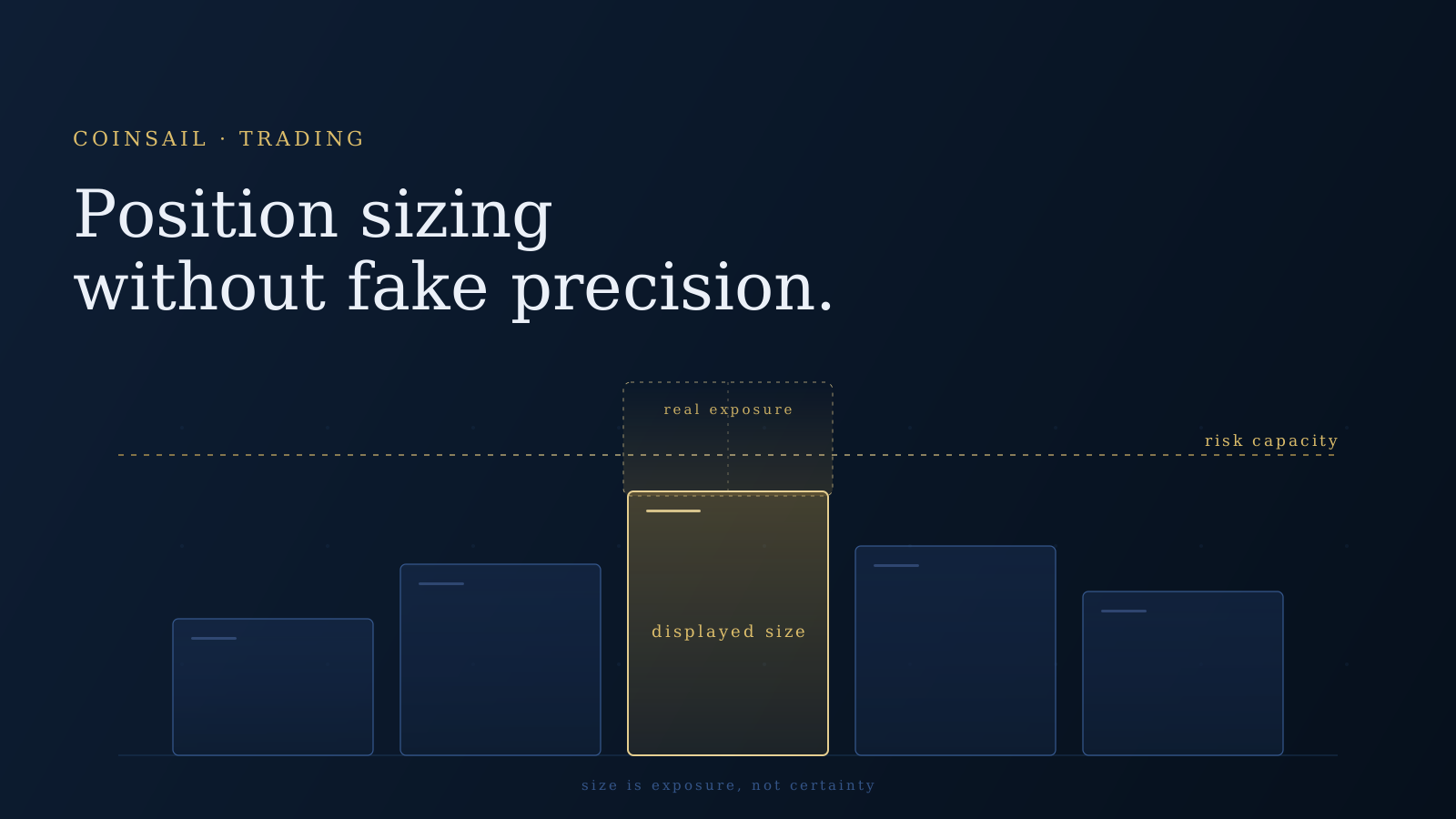
"Risk 1% per trade." "Use the Kelly fraction." "Never lose more than X." Position-sizing rules are some of the most repeated lines in trading education, and they share one quiet problem: a precise-looking number can hide whether you've actually thought about the risk it represents. A 1% rule that ignores leverage isn't really a 1% rule. A Kelly fraction calculated from a small sample is a Kelly fraction in name only. A maximum position size that doesn't account for liquidity is an aspiration about exit, not a constraint on entry.
This article is the risk-framing version. It is neither a defence of any specific sizing formula nor a prescription of a percentage. It's a framework anchored in how the SEC, FINRA, and the CFTC actually describe capacity, margin, leverage, and concentration. It is educational; it is not personalised trading advice; and it explicitly avoids telling you what your position size should be.
What position sizing actually controls
Position sizing controls exposure — the fraction of your capital that's at risk if the trade goes wrong. It does not control whether the trade goes wrong. That's the load-bearing distinction in everything that follows.
A "good" position size is one that:
- Has a defined loss number, calculated against a specific invalidation level.
- Is small enough that hitting that loss is survivable for the account and the trader.
- Doesn't quietly grow under leverage past what the displayed size suggests.
- Doesn't tip the portfolio into concentration relative to everything else you hold.
None of those things is a forecast. The market is under no obligation to reward a "correct" size with a profit — the right size and a losing trade are entirely compatible.
Why fake precision is dangerous
A number to two decimal places looks rigorous. It usually isn't, for three reasons:
- It doesn't know your capacity. A sizing rule calibrated to "I can lose X without changing my behaviour" is only as valid as the X is honest. The right number depends on your willing-vs-able gap (more on this below), not on the rule.
- It doesn't know the position's liquidity. A stop loss you can't fill at your invalidation level isn't really a stop loss — it's an order ticket. Slippage in stressed markets routinely makes the realised loss meaningfully larger than the planned one.
- It doesn't know what leverage you're applying. Under margin or other leverage, the displayed position size and the actual exposure can diverge by a lot — sometimes catastrophically. We'll come back to this in the leverage section.
A rule that produces "size = 1.27%" without checking those three things is precision theatre. A rule that produces "size somewhere in this range, after checking invalidation, liquidity, capacity, and leverage" is harder to express on a slide — but is closer to what the regulator framing actually supports.
Willingness versus ability
FINRA puts this in one line: "Being willing and able to take on a certain amount of risk are two different things, and you must make sure the risk you're willing to take is consistent with the level of risk you're actually able to take."
A trader can be willing to risk a large chunk of capital on a single position and unable to absorb the consequences of being wrong — because of where the money came from, what it's supposed to do for them later, or how much emotional capital is tied up in the trade.
FINRA's own four factors are the cleanest checklist:
- Investment objectives. Position size that puts the underlying goal at risk is too big regardless of what the formula says.
- Time horizon. Shorter time horizons reduce your ability to recover from a deep drawdown.
- Reliance on the funds at risk. If the money is essential for near-term living, education, housing, retirement, or emergencies, FINRA's day-trading guidance is unambiguous: it shouldn't be in this trade at all. Their explicit list of things that shouldn't fund speculative trading: "retirement savings, student loans, second mortgages, emergency funds, assets set aside for purposes such as education or home ownership or funds required to meet living expenses."
- Inherent personality. Some traders can hold a 30% drawdown and stick to plan. Others can't hold a 5% drawdown without making an emotion-driven decision. The "right" size differs.
Sizing should respect able. Willing is the optional upgrade you take only when able is comfortable.
Volatility, liquidity, invalidation, and time horizon
Four context factors that change what the same nominal position size means in practice:
- Volatility. A 2% position in a high-volatility instrument routinely produces deeper drawdowns than a 2% position in a low-volatility one. Sizing without reference to the instrument's volatility regime is sizing to a label, not a risk.
- Liquidity. If you can't actually exit at your invalidation level — because the market is thin, after-hours, or stressed — the "stop" is a planning fiction. FINRA, in its general framing on margin, notes that the firm "can sell your securities without notice" when their requirements aren't met. Your own exits are subject to the same liquidity reality, just from the other side.
- Invalidation. The specific price level or condition that closes the position. Without it, "size" is a number with no relationship to risk. Set it before opening the position.
- Time horizon. Shorter horizons squeeze the tolerable intra-trade drawdown. A position size that's fine over a quarter can be too large over an afternoon.
A useful sizing process treats these as inputs, not afterthoughts.
Margin and leverage
This is where displayed size and real exposure can diverge most.
The SEC's investor bulletin on margin accounts works the example explicitly: imagine purchasing $16,000 in securities with $8,000 of your own money and $8,000 borrowed from the broker on margin. If the market value of those securities falls to $12,000 — a 25% price decline — your equity falls to $4,000. That's a 50% equity loss from a 25% price move. The SEC's framing alongside the example is just as direct: "You can lose more money than you have invested." FINRA states the same anti-claim verbatim: "You can lose more funds than you deposit in the margin account."
Two more pieces matter for sizing under leverage:
- Forced sale without consultation. The SEC: "Your broker may not be required to make a margin call or otherwise tell you that your account has fallen below the firm's maintenance requirement. Your broker may be able to sell your securities at any time without consulting you first." FINRA: "The firm can sell your securities without notice." The implication for sizing is severe — the worst-case exposure under leverage is not bounded by your stop; it's bounded by what the broker can liquidate when conditions require it.
- Leverage amplifies in both directions. The CFTC's customer advisory on retail forex puts it bluntly: "This high degree of leverage amplifies both gains and losses." And separately, on outcomes: "Two out of three forex customers lose money." That second sentence is regulator data, not editorial.
The takeaway for sizing isn't to avoid leverage — it's to size against the real exposure, not the visible position size. Under leverage, those two numbers are not the same thing.
Concentration is relative
A position can be "small" in absolute terms and "concentrated" in portfolio terms, or vice versa. FINRA's definition pins this precisely: concentration risk is "the risk of amplified losses that may occur from having a large portion of your holdings in a particular investment, asset class or market segment relative to your overall portfolio."
Two specific ways the trap shows up:
- Intentional concentration. Deciding deliberately to put more into a single trade or sector. This is honest, but it's still concentration — and it deserves the larger drawdown that comes with it.
- Performance drift. A winning position becoming a larger share of the portfolio because it appreciated. The size discipline that was right when you entered isn't necessarily right after the position has doubled. FINRA flags this explicitly: "Maybe one of your investments has performed very well relative to the rest of your portfolio."
The honest sizing question isn't "how much am I putting in?" It's "what share of total capital is this, including what's already running?"
A practical sizing checklist
Seven questions a careful reader can ask before opening any trade. None of them produces a single magic number — and that's the point.
- Is the invalidation written down — before opening the position?
- Can you realistically exit at that invalidation level, given current liquidity?
- Is the willing loss honest about the able loss? Three consecutive losses at this size — would the account and the trader survive intact?
- Does the position stay within your concentration boundaries relative to total capital, not in isolation?
- What is the leverage multiplier? If there's margin or other leverage, what's the worst-case exposure under the "lose more than you deposit" framing?
- What's the time horizon? Does the size tolerate the drawdown a position of this duration realistically produces?
- Are the funds at risk not on FINRA's explicit "shouldn't fund speculative trading" list — retirement, student loans, mortgages, emergency funds, education, housing, or living expenses?
A position that fails any one of these is too big regardless of what the formula says.
Common mistakes
A few failure modes show up repeatedly:
- Treating size as a confidence dial. Sizing up because you're "more sure" mistakes feeling for analysis. Confidence is not a sizing input.
- Sizing off a stop you can't fill. A 2% planned loss with a 4% realised loss isn't a 2% strategy.
- Ignoring leverage. A 1% rule layered on top of margin can be a 3% rule in disguise.
- Letting winners drift into concentration. Size discipline is set at entry, but concentration is decided continuously.
- Letting the formula produce a number you wouldn't have chosen by hand. If the output feels wrong, the inputs are probably wrong.
Risks and limitations
A few honest limits worth keeping visible:
- Sizing reduces some risk; it does not eliminate it. Every investment carries some level of underlying risk regardless of how it's sized. A position sized carefully can still lose money — that's the operating environment, not a failure of the sizing process.
- No formula in this article. None of the cited regulator sources endorses a universal sizing percentage or formula, and neither does this article. Treat any rule of thumb as a starting point you check against capacity, liquidity, invalidation, leverage, and concentration — not as the answer.
- Educational, not personalised trading advice. What size suits your account, your circumstances, and the instruments you trade is a personal question. The framework is the same; the numbers are not.
Bottom line
A useful sizing process makes the loss surface of the trade visible before the trade opens. It does that by treating size as a conversation between your invalidation, your capacity, the position's structure, and any leverage in play — not as the output of a formula calibrated on assumptions you didn't verify.
Regulators consistently emphasise that retail trading carries real loss risk, that leverage amplifies it, and that no universal rule fits every person or context. A sizing process that respects those three facts isn't a guarantee of better outcomes. It's something quieter and more useful: a refusal to take a trade whose worst case you haven't honestly stared at.
Sources used
- FINRA — Know Your Risk Tolerance — the willing-versus-able-to-take-risk distinction and the four-factor risk-tolerance framework.
- FINRA — Understanding Margin Accounts — the margin mechanics, the "lose more funds than you deposit" warning, and forced sale without notice.
- SEC Investor.gov — Investor Bulletin: Understanding Margin Accounts — the SEC's worked margin example (25% price decline → 50% equity loss on a margined position) and the explicit "lose more money than you have invested" caveat.
- FINRA — Concentrate on Concentration Risk — the definition of concentration risk as relative to total portfolio, plus intentional vs performance-drift concentration.
- FINRA — Day Trading — the explicit short-term-trading suitability and capacity caveats; "be prepared to lose all of the funds used for day trading"; the named list of resources that should not fund speculative trading.
- CFTC — Customer Advisory: Eight Things You Should Know Before Trading Forex — the explicit "two out of three forex customers lose money" finding and the "leverage amplifies both gains and losses" framing.
"Sizing is the conversation between your invalidation, your capacity, and the position's structure. A useful sizing process makes the loss surface of the trade visible and acceptable before the trade opens — it does not promise the trade will work."
More in this category

The Trading Journal That Actually Works
A trading journal is a review system, not a profit engine. A calmer, source-backed framework for what to record before, during, and after a trade — anchored in the SEC and FINRA's own framing of recurring investor mistakes.
10 min read · CoinSail Editorial